

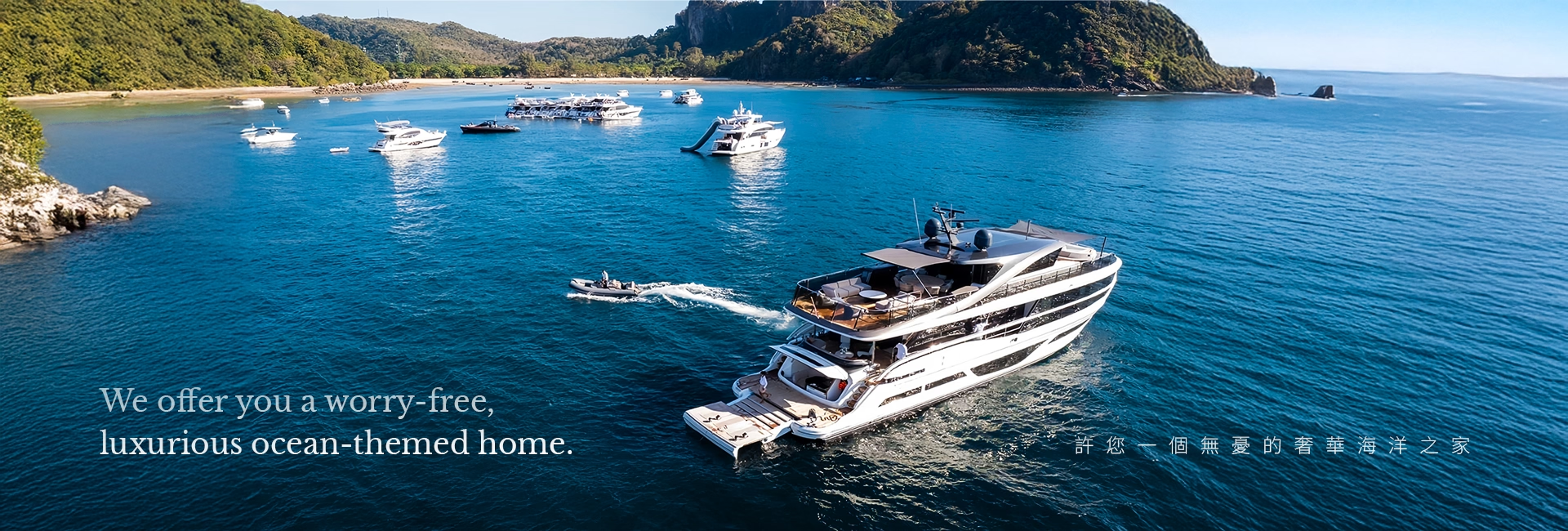
Witnessing the craftsmanship behind the price tag through the birth of the Princess S80.
When many people see a luxury yacht worth tens of millions or even hundreds of millions, the first question that pops into their minds is usually: "Why are yachts so expensive?" Is it a gold-plated toilet? A deck covered in teak? Or a champagne ice bucket on the deck?
But those who truly know boats will tell you: the most expensive parts are the ones you cannot see.
British yacht brand Princess Yachts invited Nick Burnham, host of the YouTube channel Aquaholic, into the heart of their Plymouth factory to document the step-by-step production of a brand-new Princess S80 from scratch. In this article, we take you inside this yacht-building giant—which employs over 3,000 people across six production sites yet manufactures only 200 to 300 luxury yachts a year—to see how the "price" of a luxury yacht is actually constructed.
This is not just boat building; it is a comprehensive test of technology, craftsmanship, labor, and space management.
This article takes you into the core content of the full 36-minute video, not only sharing a summarized breakdown but also analyzing the finer details that average viewers tend to overlook, letting you truly understand: Luxury is not ostentation, but strength built upon thousands of layers of craftsmanship.

Princess Yachts is one of the most iconic luxury yacht brands native to the UK. Their factories are concentrated in Plymouth, totaling seven manufacturing bases that span over 1.1 million square feet, equivalent to 20 football fields. Moreover, all of them are dedicated exclusively to handcrafting yachts.
It might be hard to imagine, but Princess Yachts only produces about 200 to 300 boats per year. On average, it takes approximately 35,000 hours of manual labor for a boat to go from the start of construction to completion. Strictly speaking, this is not a highly efficient company.
Yet, it is precisely because they do not engage in mass production that they can maintain a near-luxury boutique level of manufacturing.
The Princess S80 we see today was born under exactly this kind of rhythm.
Walking into the manufacturing site of the S80, the first thing that catches your eye is not a boat, but something larger than a boat: a 1:1 mould.
The hull mould for this vessel is 80 feet long and is a one-to-one internal mould used to produce the bottom shell structure. This mould is not something casually tossed away after being used a few times; it accompanies the entire product life cycle of the S80 model.
And that is exactly why it must be so precise. To ensure a flawless mould surface, Princess utilizes a massive 5-axis CNC processing machine to create the prototype, controlling errors within ±1mm. There is a specific constraint in mould design: it cannot have any "undercuts". This is because after the resin is infused, the entire boat must be cleanly "pulled out" from the mould, otherwise, it gets stuck and becomes waste.
The cost of constructing such a set of moulds conservatively starts at hundreds of thousands of pounds, sometimes even exceeding the price of an entry-level boat model.
The South Yard of Princess was formerly a naval shipbuilding base for the Royal Navy. It is precisely because they possess this kind of space and facilities that they can manufacture large-scale hulls above the 80-foot class.
Once the mould is ready, construction officially enters the next stage, which is what we call the "lamination process".
Princess employs a composite structure consisting of a fiberglass and foam sandwich, completing the resin penetration via vacuum infusion technology. This is currently the most mainstream method for high-end yachts.
To put it simply, layers of fiberglass and foam are placed inside the mould first, then covered with a vacuum bag. After drawing a vacuum, a precisely proportioned resin is infused.
Sound simple? But there are actually a ton of tricks to it:
- If infused too quickly, bubbles or unsaturated areas will form (making it brittle).
- If infused too slowly, the foam will deform or delaminate beforehand (causing warping).
- If there is a bit too much resin, the boat becomes heavy; if there is too little, structural issues will arise.
Internal factory personnel mentioned that some large sections are estimated to require the precise infusion of 600 kilograms of resin, and the process cannot be interrupted. This is not just a technique; it is a precise science of "mathematics".
Furthermore, that layer of foam is certainly not expanded polystyrene or styrofoam, but a high-density core material named Corecell. Sourced from the aerospace and military fields, it balances lightweight properties, compressive strength, insulation, and stability, commanding an incredibly high unit price. This is why Princess dares to use this material throughout the entire underwater structure, whereas other brands typically only use it on decks or non-load-bearing areas.
Therefore, much of the cost of a luxury yacht is hidden away just like this, inside the "foam within the walls" and "infusion data you cannot see".
This entire process makes the Princess hull lighter in weight, higher in strength, and significantly quieter, truly embodying "invisible luxury".
After the infusion is finished and the hull has cured, the most critical move is pulling the boat out of the mould.
Princess's method is to first bond several temporary ribs inside the hull, and then use lifting equipment to hoist the entire boat, slowly pulling it out from the mould.
During this process, if anything is miscalculated, if the adhesive is not tight, or if the angle is wrong, the newly completed shell could crack. Watching the workers operate on-site, the host Nick couldn't help but ask: "You just hoist it up like that and hope it doesn't pop apart?"
But the fact that Princess can achieve this consistently proves we have immense confidence in our structural rigidity, mould precision, and bonding strength. For a yacht of this caliber, this very step begins to test the brand's true mastery of quality.
The hull pulled out from the mould is actually just like an eggshell; it looks complete, but there is nothing inside yet.
The next step is to install the structural reinforcement system—namely, the "skeleton".
You might ask: since fiberglass is already so hard, does it still need reinforcement?
The answer is yes. Because an 80-foot long boat experiences severe shearing and torsional forces when navigating at high speeds. Without longitudinal stringers and bulkheads installed at the bottom of the boat and within the cabin, the entire boat would feel like a twisting plastic bottle.
Princess utilizes prefabricated stringers, matching them with structural adhesive and precise positioning to fix the skeleton system inside the hull. The distribution design of these ribs is not based on guesswork or mere intuition; it is a structural design result simulated through FEA (Finite Element Analysis).
In other words, when you are sitting in the salon of the S80 sipping champagne, that sense of "stability" isn't actually given by the designer—it is calculated by the engineer.
You might think that once the hull is de-moulded and the ribs are fitted, the entire boat is already "grown and completed," but it is actually still like a physical shell that hasn't been fitted with nerves yet.
Starting from the latter half of the video, we see a phase that is incredibly easy to overlook but carries exceptionally high costs and technical requirements: wiring harness fabrication.
The wiring harnesses for each Princess yacht are entirely handmade, individually numbered, and custom-tailored to the specific project. These harnesses do not use mass-produced modules like home appliances; instead, they are completely re-engineered and routed according to the configuration of each individual boat—how many screens, how many sets of light fixtures, how many air conditioning units the client selected, and what brand of navigation system is used.
This circuitry production is not carried out on the boat itself. Instead, it takes place in the electrical department within the factory grounds, where technicians stand before massive jig boards, cutting, crimping, labeling, and binding cables one by one according to the engineering drawings. They even conduct electrical tests beforehand to confirm that all circuits close normally before delivering them to the boat for installation.
Many people think "wiring is just plugging things together, how hard can it be?" But on a boat, especially a luxury yacht with hundreds of electrical points, the electrical system is actually one of the most difficult to standardize, hardest to repair, and most dreaded areas should an issue arise.
That is why Princess chooses this most traditional yet most stable method to build the nervous network of an S80.
In this video, what we are seeing is actually just the first stage of the S80's manufacturing: moulding, lamination, de-moulding, structure, and wiring.
It doesn't have engines yet, no windows, no furniture, and it hasn't been launched into the water for sea trials. Yet, just reaching this step has already consumed hundreds of thousands of pounds in costs. And almost none of these investments are visible to the consumer's naked eye.
This is the world of luxury yachts.
It is not extravagance, but precision. It is not flamboyance, but dedication. When you see a Princess S80 resting quietly at the dock, never assume it is just a "rich man's toy." It is actually the summation of craftsmanship—a miracle layered together by hundreds of artisans, designers, and engineers spending tens of thousands of hours of painstaking effort.
🛠 In the next article, we will continue into Princess's assembly line to see how this empty vessel is fitted with engines, interior appointments, and mechanical/electrical systems, becoming a true vessel of dreams capable of sailing into the ocean.